mach#
mach#




An ultrafast CUDA-accelerated ultrasound beamformer for Python users. Developed at Forest Neurotech.
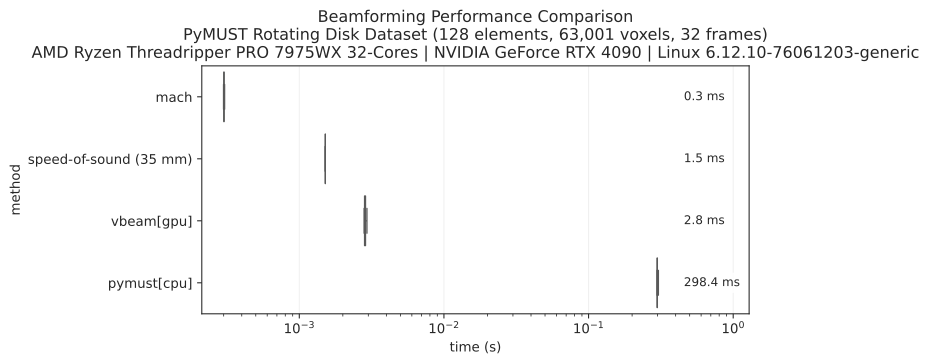
Benchmark: Beamforming PyMUST’s rotating-disk Doppler dataset at 1.1 trillion points per second (6.5x the speed of sound).
Highlights#
⚡ Ultra-fast beamforming: ~10x faster than prior state-of-the-art
🚀 GPU-accelerated: Leverages CUDA for maximum performance on NVIDIA GPUs
🎯 Optimized for research: Designed for functional ultrasound imaging (fUSI) and other ultrafast, high-channel-count, or volumetric-ensemble imaging
🐍 Python bindings: Zero-copy integration with CuPy, and JAX arrays via nanobind. NumPy support included.
Installation#
Install from PyPI (recommended):#
pip install mach-beamform
Or: to include all optional dependencies, including to run the examples:
pip install mach-beamform[all]
Wheel prerequisites:
CUDA-enabled GPU with driver >= 12.3, compute-capability >= 7.5
Build from source#
make compile
Build prerequisites:
Linux
makeuv >= 0.9.7gcc >= 8nvcc >= 11.0
Docker Development#
Compile and test without installing the CUDA toolkit using our Docker development environment.
Prerequisites:
Docker Engine with nvidia-container-toolkit
CUDA-capable GPU with driver >= 12.3
Quick start:
# Build and start development container
docker compose run --rm dev

# Or use make shortcuts
make docker-build  # Build image (first time: ~2-3 min, rebuilds: ~30s)
make docker-dev    # Run container
Inside the container:
make compile  # Compile CUDA extension
make test     # Run tests
Your source code is mounted from the host, so you can edit files locally and compile in the container. Build artifacts (.venv/ and build/) are stored in anonymous volumes to avoid permission issues. Dependencies are pre-installed in the image and cached, so rebuilds are fast when only source code changes.
Examples#
Try our examples:
If you don’t have a CUDA-enabled GPU, you can download the notebook from the docs and open in Google Colab (select a GPU instance).
Contributing#
We welcome contributions! Please see CONTRIBUTING.md for guidelines.
Roadmap#
Beta release (v0.Y.0)#
✅ Single-wave transmissions (plane wave, focused, diverging)
✅ Linear interpolation beamforming
✅ Allow NumPy/CuPy/JAX/PyTorch inputs through Array API
✅ Comprehensive error handling
✅ PyPI packaging and distribution
✅ Interpolation options: nearest, linear, and quadratic
Numerically validated, but looking for feedback on API#
✅ Coherent compounding
See the project page for our up-to-date roadmap. We welcome feature requests!
Acknowledgments#
mach builds upon the excellent work of the ultrasound imaging community:
vbeam - For educational examples and validation benchmarks
Community contributors - Gev and Qi for CUDA optimization guidance
This package was developed by the Forest Neurotech team, a Focused Research Organization supported by Convergent Research and generous philanthropic funders.
Citation#
If you use mach in your research, you can cite:
@article{mach,
  title = {mach: ultrafast ultrasound beamforming},
  author = {Guan, Charles and Rockhill, Alexander P and Sode, Masashi and Pinton, Gianmarco},
  year = 2026,
  journal = {Journal of Medical Imaging},
  publisher = {Society of Photo-Optical Instrumentation Engineers},
  volume = 13,
  number = 6,
  pages = {062203--062203},
  doi = {10.1117/1.JMI.13.6.062203},
  url = {https://github.com/Forest-Neurotech/mach}
}
Examples:
Performance:
API Reference: